Back to School Basic Skills Assessments: A Practical Guide for Educators
The start of the school year is a critical time for educators. It's not just about getting students into their seats and starting lessons—it's about understanding where each child stands in terms of foundational skills. Back to School Basic Skills Assessments offer a structured approach to evaluating early learners, ensuring that teachers can tailor their instruction to meet individual needs right from the beginning.
Evaluating Foundational Skills with Precision
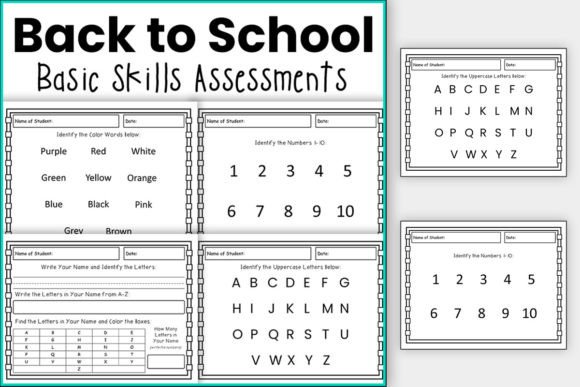
Every student enters the classroom with a unique set of abilities and gaps. Without a clear understanding of these, it's easy for educators to fall into the trap of teaching to the middle while leaving some students behind. Back to School Basic Skills Assessments provide a solution by offering targeted evaluations that focus on essential areas such as letter recognition, number identification, color awareness, and name tracing.
These assessments are designed to be thorough yet straightforward. They cover uppercase and lowercase letters, numbers up to 50, colors, and color words—key elements that form the foundation of early learning. The inclusion of activities like name tracing, letter counting, and identification ensures that students are not only tested but also engaged in meaningful practice.
Progressive Difficulty for Every Learner
One of the standout features of this assessment bundle is its progressive difficulty. Instead of presenting all students with the same level of challenge, the assessments span various difficulty levels. This allows educators to gauge each student's proficiency accurately and adjust their teaching strategies accordingly.
For example, a student who struggles with numbers 1-10 might benefit from more support and repetition, while another who has mastered numbers up to 50 could move on to more complex tasks. This tiered approach ensures that no child is left behind and that all learners are appropriately challenged.
Tracking Progress with a Data Chart
Assessment is only the first step. What matters most is how that information is used. That’s where the included data chart comes in. This tool enables educators to monitor individual progress over time, making it easier to identify strengths and areas for improvement.
By tracking data consistently throughout the school year, teachers can make informed decisions about instruction, intervention, and support. The data chart simplifies the process of identifying patterns, which can lead to more personalized learning experiences for students.
What’s Included in the Assessment Bundle?
- Identifying Uppercase Letters
- Identifying Lowercase Letters
- Identifying Numbers 1-10
- Identifying Numbers 1-20
- Identifying Numbers 1-30
- Identifying Numbers 1-40
- Identifying Numbers 1-50
- Identifying Colors and Color Words
- Trace Name, Count Letters, and Identify the Letter from Sheet
Each assessment is carefully crafted to align with common learning objectives and developmental milestones. The variety of formats—PDF, JPG, and PNG—ensures flexibility in how educators choose to use the materials, whether for print or digital distribution.
Practical Implementation Tips
Administering Back to School Basic Skills Assessments should be a seamless part of your planning process. Start by scheduling time at the beginning of the school year to conduct these assessments. Use the results to create individualized learning plans and group students based on skill levels.
Don’t forget to utilize the data chart regularly. Set aside time each week or month to review progress and adjust your teaching strategies as needed. This ongoing monitoring helps ensure that every student receives the support they need to succeed.
Why These Assessments Matter Now More Than Ever
In today’s fast-paced educational environment, having a reliable resource like Back to School Basic Skills Assessments is more important than ever. With increasing demands on educators to differentiate instruction and provide personalized learning, these assessments offer a practical solution that saves time and enhances effectiveness.
Moreover, as remote and hybrid learning models continue to evolve, having a flexible and comprehensive assessment tool becomes essential. Whether you're working in a traditional classroom or an online setting, these assessments can be adapted to fit your needs and support your students’ growth.
Conclusion
Back to School Basic Skills Assessments are more than just a collection of tests—they’re a valuable resource that empowers educators to start the school year with confidence and clarity. By focusing on foundational skills, providing progressive challenges, and offering tools for tracking progress, this bundle supports both teacher and student success.
As the educational landscape continues to change, having a strong foundation in basic skills assessment is key to meeting the diverse needs of learners. With the right tools and strategies, educators can create a welcoming and effective learning environment that sets students up for long-term success.